
The sport of field-trialling has been around for over a hundred years in Ireland. It was started in Britain in 1865 and was developed by landed gentry and wealthy sportsmen.
Its purpose was to find which of this elite group had the best gun dogs. Pointing dogs were greatly admired at that time, as before the advent of driven game, pointers and setters were the mainstay of the shooting world. Apart from being a most enjoyable pastime, field-trials play an important part in the development and maintenance of working gun dogs. Field-trials were started by the aristocracy of England for the same reasons as horse racing, in that the measure of a man was whether he had a faster horse or a better dog than his neighbour. These people had the wherewithal to keep large kennels of shooting dogs on their estates to provide them with pleasure in their pursuit of game. It was a natural step to start to compete against each other to find out just how good their dogs were. It was not very long before similar competitions were started in other countries and they are now found all over the world.
The incredible ability of these dogs never ceases to amaze me. Their courage, pace and ability in the search for game in rough, uneven terrain is a source of unending wonder. Their concentration on finding game, their total immobility when game has been located, the accentuated pause before the killing rush, something seen in almost all large predators, is very exciting to experience. This partnership with man is almost as old as mankind, stemming from the time when the wolf first joined man at the fireside and helped him in his hunt for food. Pointers and setters represent the ultimate development of the wolf. They combine a beauty of form, of intelligence, integrity and instinct that is unsurpassed. They are a source of inspiration and symbolise the ability of man to control his surroundings.
The growth of trials as a pastime has been enormous. The differences now seen in the rules and regulations around the world are a result of the varying hunting conditions in different lands. Many countries have exploited this great surge of interest in trials and organised field-trials to include anyone wanting to compete with their dog. In several European countries hundreds of dogs are presented on each trial day, and as many trials as are necessary are organised to accommodate the dogs entered. As a result, the sport has developed to a far greater degree in many other countries than in the land of its origin. Professional trainers cater for the needs of those who are interested in the sport but do not have the time needed to train and present dogs themselves. In general, the standard of these trainers is very high. Amateurs who compete on this level are required to have top-quality dogs that have sufficient polish to win against the professionals.
The Scandinavian kennel clubs have also encouraged the growth of the sport by licensing several trials per day to cater for the expanding number of participants. Scandinavian trialers are mostly the owners of one or two dogs that are invariably kept in the house. There are very few large kennels, yet the trialling public is enormous. Norway, although having a similar population to Ireland, boasts a far greater following. The Norwegian rules have been developed to find the best hunting dog, as the rules are lenient and encourage the shooting fraternity to exhibit their dogs. As a result of this the sport is in an extremely healthy state, with greater numbers of people participating every year.
In the United States, there is an enormous following for trials. The American Field is a weekly magazine that covers trials that run the length and breadth of the States and even in Japan. Trials are run under the auspices of the Field Dog Stud Book and place great emphasis on stamina and range. The more prestigious trials are the horseback trials, where the handlers, judges and gallery are mounted. The heats vary from one hour to three hours in duration, requiring a hard-hunting. forward-running dog with plenty of bottom. While these trials are a great spectacle I think that they have lost touch with reality in many respects. The extensive use of released game and the development of the horseback trials to the exclusion of foot-hunting trials divorce the sport from practical hunting and from the hunter, which is never a good thing for gun-dog breeds.
The world over, these developments have allowed the sport to mature and can only improve the overall quality of the dogs, as the broadening of bloodlines gives the breeds a better genetic base. Our competitive nature drives us to strive to gain the highest honours and this is as true in field trials as in any other sport. Breeders strive for excellence and field-trials are the testing ground to prove that excellence. Everybody has heard owners boast about the dogs, but at a trial the naked facts are there for everyone to see. Prospective breeders should attend trials in order to select the lines that can help to improve the breed. The ability of a trainer plays an important part in the finish of any dog, but no trainer can greatly improve the inherent qualities of a dog, hence the emphasis of the more informed judges on style. However, it should be said that dogs trained exclusively on certain types of ground and game may not be shown to the best of their ability. For example, dogs trained and developed in fields never do themselves justice on the open mountain, as they lack the experience of dealing with the change in ground and game.
It is necessary to look carefully at the young dogs, as at this stage the natural ability of the dogs is at its most obvious. Trainers that over-influence or dominate their charges in any way can end up with an inferior trial prospect compared to those who have the ability and knowledge to finish their dogs by working with the natural abilities of the dog. The guidelines for anyone interested in trials to follow are: to train hard but do not overdo it, give your dog as much experience of finding and handling game in different types of terrain and weather as possible, try to make hunting a combined effort between man and dog, and trust your dog on the day of the trial.
Success at trials goes to those who work their dogs the hardest. The odd fluke may occur, but it is better to have your homework done if you wish to end up at the awards ceremony. Good trainers and handlers present their dogs at their best, which may be better than the overall performance of dogs that have not had the benefit of a serious trainer. As in all walks of life, there will be those whose desire to win drives them to use any means possible, fair or foul. Such people harm whatever sport they participate in and should be shunned. Their quest for self-glorification will destroy whatever they touch by the negativity of their greed.
Over the years I have heard many shooting men denigrate trials, saying that the dogs are too fast and difficult to handle and are not easy to shoot over. It should, however, be remembered that at trials dogs are only run at an all-out pace for a short period and they adjust their pace when being shot over in order to last a full day’s work. The truly top trialers have the intelligence to handle all types of terrain and game and invariably make brilliant, exciting dogs to shoot over. Without the presence of such dogs, a breed can degenerate towards the average and will in time lose vigour and become mediocre.
The great trial dogs all share one thing: intelligence. Of course, they must have the inherent instincts and abilities of their race, but the thing that raises them above the average is their superior intelligence. Dogs that truly understand the nature of competition use all their senses, the ground and the wind, and can even interpret the actions of their bracemate in order to win the race to game. They understand the competition, enjoy it and glory in their own ability and success.
The truly brilliant trialer possesses physical, mental and instinctive capacities above the norm, and these qualities permit the dog to display its ability in public, to shine in the company of other top dogs and to win its share of prizes. The interaction between conformation and the desire to find game make them persistent hunters, nose, intelligence and instinct allow them to find and handle game, and temperament refines these qualities so that their work is in sympathy with the handler. The handler must play his part in their development and handling. The best handlers are silent and unflappable and display a trust in their dogs to do their work without interference, reflecting that ‘every perfect action hath the grace of indolence’.
The great benefit of field-trials is that they promote dogs that have the possibility to be a positive influence on their breed. Like begets like not always, but often enough to maintain the working ability of the race. Clearly it is an imperfect sport, as all the qualities that constitute a top-class dog cannot be seen in a quarter of an hour. However, those who regularly attend trials will soon get to know the faults and failings of any particular dog. Despite its imperfections, the sport offers an outdoor pursuit, a chance to indulge our own needs to fit into the natural order, to see aspects of nature unknown to many. To those who have never felt the cut and thrust of competition, seen the speed and pace of the dogs as they vie with each other, gloried in the rush of adrenaline when your dog makes game, to you I say this: the beauty of the quest has been denied to you and you have missed out on one of life’s great pleasures.
(Credit – Raymond O’Dwyer, The Irish Red Setter It’s History, Character and Training)
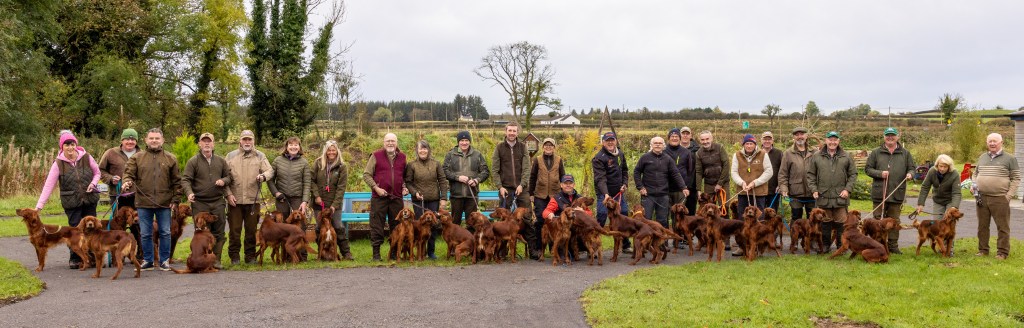
Group Photo at the 2024 European Championship for Irish Red Setters on Snipe.
.
 Irish Red Setter Club